
Tim Thorne, TAP: Take community opposition to a Tamar Valley pulp mill into account
Tim Thorne Media Officer, Tasmanians Against the Pulp Mill Inc.
15.01.14 4:28 pm
Anyone interested in purchasing the plantation and forest assets of
failed company Gunns Ltd would be well advised to take community
opposition to a Tamar Valley pulp mill into account as part of their due
diligence research, according to TAP spokesperson Mr Tim Thorne.
Mr Thorne said today that the permits for construction of the mill were
still subject to a challenge in the court, adding an element of risk to
such a large investment.
“Without certification by the Forest Stewardship Council pulp from the mill would be unsaleable, ” Mr Thorne said, “and such certification would certainly not be granted if feedstock for the mill was sourced from unsustainable land management practice.”
“No mill of the size proposed can operate profitably using only the currently available plantation timber due to the lack of both quality and quantity of the Tasmanian resource. There has been no replanting of this resource since the collapse of the company and the industry, so the long-term outlook for investment in this venture is bleak indeed, ” Mr Thorne said.
“TAP believes that what is needed is proper plantation restoration management with alternative tree species, aimed at best practice in resource value recovery, based on whole life-cycle assessment processes, ” Mr Thorne said.
“There are alternative product development options that have so far deliberately not been examined by those who wish to keep promoting the long worn-out pro pulp mill case in the public arena,” he added.
___________________________________________________________________
MESSAGE TO POTENTIAL PERMIT BUYERS
MEDIA RELEASE November 7 2013
TAP Into A Better Tasmania spokesperson Tim Thorne today reminded any potential buyer of the Gunns proposed pulp mill concept that the economic, social and environmental case is totally unviable.
‘With Australian wages among the highest in the world, the pulp mill
concept is more about saving face for the two major political parties
than about providing an already plentiful commodity to a dwindling and
distant market. Manufacturing is deserting Australia in droves and this
is a situation the politicians have created themselves. In their
desperation to save their own tax base they have written a permit that
allows for the effluent dioxin contamination of Bass Strait,’ said Mr
Thorne.
‘The 2007 Pulp Mill Assessment Act, with its pernicious “Section 11” has
disenfranchised the entire Tamar Valley community, so there will be no
social licence, therefore no Forest Stewardship Council certification,
and so no customers,’ Thorne said.
‘Other issues surrounding the mill concept include the inadequacy of local feedstock supply, the huge burden on local government in upkeep of roads to cope with a log truck or a big chip-truck every two minutes, and the impact on domestic water supply from the Trevallyn Dam,’ Mr Thorne added, ‘not to mention the absurdity of a wood-fired power station next door to a mothballed LNG-fired one.’
‘This is not a realistic proposal but a fantasy dreamed-up by politicians who have never worked in a real business in their lives,’ concluded Thorne.
DIRTY MILL, DIRTY MONEY
MEDIA RELEASE February 10th 2012
Yesterday Gunns announced that the foreign owned Richard Chandler Corporation intends taking a stake in the once powerful but now much diminished company.
“This announcement unleashed a torrent of unseemly and immature language from politicians and business leaders”, said TAP spokesperson Bob McMahon.
“It would have served Tasmania much better if our politicians and business leaders had been more temperate in their language and behaviour and had their highly paid advisors do some homework on the corporation that is set to control Gunns and control many of Tasmania’s resources of land, trees and water. One would have expected a modicum of due diligence from our leaders but embarrassingly that was not on display yesterday.
“Instead of being ‘thrilled’ and declaring Tasmania ‘open for business’ it would have been much better if the Premier had shown more self control and done some homework on the Chandler Corporation before coming across like some groupie at a rock concert.
“To be fair to the Premier, the behaviour of the Leader of the Opposition was even worse, if that’s any consolation.
“There are many questions the Premier and the Leader of the Opposition should be asking of the Chandler Corporation, as should all Tasmanians.
“For example, is it true as reported in the Dow Jones Newswires, that a Swiss court ordered the Chandler owned Sovereign Finance Group to close following alleged money laundering activities in Russia and the Caribbean?
“Is it true that a police search of the Zurich offices of Sovereign (Forex) Ltd, Sovereign Capital Management AG, Sovereign Finance Group AG and the Zurich branch of Sovereign Bank Corp Ltd prompted the court’s closure order?
“Is it true that in addition to the money laundering allegations, the company was ordered to close because it did not have a banking license?
Greg L’Estrange of Gunns said “people around the world know Richard Chandler Corporation by reputation. They have a high governance and ethical standard”.
“Yet according to investigative journalist Robert Eringer, Chandler has also been thrown out of Dubai and Monaco for money laundering. Is it also true, as Eringer alleges, that Chandler was also guilty of running an unregistered commodity trading company?
“Richard Chandler is an investor in Gazprom, the Russian energy company. To quote Eringer: “Richard Chandler, a Monaco resident from New Zealand, is listed in Monaco’s police files as ‘holding a significant portion of capital of companies related to Russians connected to organized crime, and laundering money in relation to such.’”
“The questions Tasmanians will be asking of our politicians and business leaders is this: If only some of this is true is Tasmania open for this sort of business?
“Furthermore, do our politicians and business leaders even care, so blinded are they by the prospect of getting a pulp mill at any cost,” concluded McMahon.
CONTACT: Bob McMahon
RALLY and MARCH - DEMOCRACY BETRAYED – TASMANIANS BETRAYED ROYAL PARK LAUNCESTON Saturday May 14th 2011 at 11.30am.
“We’ll be flying hundreds of black flags”, said Bob McMahon TAP spokesperson.
“The flags and the choice of black as the colour of the rally is to signify those dark days in March 2007 when the great betrayal of our democracy took place.
“That was when the Pulp Mill Assessment Act, the ‘fast track’ assessment, was rubber stamped through both houses of parliament by Labor and Liberal. The only dissent was from the four Greens in the lower house and a handful of honourable independents in the upper.
“Let’s be absolutely clear as to what happened back in March 2007. The legislation was substantially written by the company which it so obscenely favours – this they have never denied – and the bill was escorted through the corridors, bar, and chambers of Parliament by a squad of lobbyists, lawyers and heavies from Gunns, the CFMEU and the logging industry.
“It was tantamount to a coup d’etat.
“That Labor and Liberal politicians and their fellow travellers in the upper house were the willing patsies of this gross abuse of parliamentary democracy should never be excused or diminished in any way,” continued McMahon.
“It was one of the most shameful episodes, perhaps THE most shameful episode, in out political history. It demonstrated a breathtaking contempt for the institution of parliamentary democracy by the very parliamentarians whose sacred duty it was to uphold.
“The great irony is that it was all for nothing,” said McMahon. “There is no pulp mill. Not a single cent of investment money has been attracted to the project in six and half years. It remains, as it always was, a grand delusion. Yet unprincipled government has wasted vast sums of public money on it, money that should have been allocated to health, education, policing, aged care etc.
“The pulp mill is over. The nightmare of an uncompetitive, world scale resource gobbling industry for an island that is not world scale, has held Tasmania back for six and a half years.
“Let us get on with what we do best in Tasmania, establishing innovative, creative, small to medium business directed at the quality end of the market.
“The pulp mill has already destroyed two premiers. As sure as night follows day it will destroy a third unless she cuts herself free from the mill insanity and embraces and articulates a positive vision for Tasmania,” concluded McMahon.
RALLY SPEAKERS
Dr Frank Nicklason, Royal Hobart Hospital and a Gunns 20.
Peter Cundall, campaigner without peer.
Lucy Landon-Lane, Pulp The Mill.
Kim Booth, Greens.
Bob McMahon, TAP spokesperson.
CONTACT: Bob McMahon 0448 547290 or 63944225
3 March 2011 Joint Media Release TAP Into A Better Tasmania (TAP) and Tasmanian Public and Environmental Health Network (TPEHN)
Community Groups TAP and TPEHN join in condemning the ‘forest principle agreement’ because it is very specifically tied to the delivery of the Gunns' Tamar Valley pulp mill.
As reported in The Australian yesterday, Bill Kelty said ‘green’ groups must strike a deal on the Gunns' Tamar Valley pulp mill or miss out on permanent protection of 565,000 hectares of native forest.
“There you have it. This is what the ‘roundtable’ negotiations have been about all along,” commented Dr Alison Bleaney of TPEHN.
“From the point of view of Gunns and the Labor Party, the forest ‘roundtable’ was about delivering the Long Reach pulp mill. From the ENGO’s side it was about delivering protection to native forest. They were the two glittering prizes up for grabs and to pretend otherwise is misleading,” said TAP spokesperson Bob McMahon.
“In order for both sides to get what they wanted it was important to exclude the community first and foremost. Why? Because it was expected that the community would be opposed to any trade-off of the sort so bluntly expressed by Kelty”, continued McMahon.
“After all, the community was going to have to pay the price for the sort of deal the forest industry negotiators had in mind. The community had to be sidelined and kept in the dark. Thus the secrecy. We were the sacrifice."
“That the blatantly undemocratic, rigged and secret ‘roundtable’ negotiations and the ‘forest principles’ that resulted (including in principle support for plantations and ‘a pulp mill’) received the enthusiastic support of the ALP is no surprise."
“That the Greens have also been enthusiastic supporters of the undemocratic negotiations as constituted, and the ‘forest principles’ that resulted from the illegitimate process, is deeply distressing for the community and incredibly damaging to the Greens themselves,” said McMahon.
“Kelty has made it abundantly clear that the success of the Gunns/ALP pulp mill is dependent on the signing of the ‘forest principles agreement’,” said Dr. Bleaney.
“Therefore, both TAP and TPEHN, demand that The Wilderness Society, Environment Tasmania and Australian Conservation Foundation either refuse to sign the agreement as it exists or insist that the Gunns Tamar Valley pulp mill be specifically excluded from the agreement as a principle."
“We expect many other community groups will join us in making this demand”.
“It is not too late for the Greens to redeem themselves either”, confirmed Bob McMahon. “They will have to stop the doublethink and unequivocally withdraw their support for the ‘forest principles’ as they stand and the illegitimate roundtable process which produced them. It is not good enough for the Greens to say they do not support the Tamar Valley pulp mill while supporting a process designed from the very beginning to deliver that very same pulp mill.
“Dr Bleaney and I want to put this bizarre chapter of Tasmanian history into context. This is a monumental issue of social justice. Should the environment groups sign up to the ‘forest principles’ deal as it currently exists it will be viewed as a great betrayal of current and future generations of Tasmanians, whose social, economic and environmental horizons will be severely diminished and restricted by the demands Gunns mill will place on our basic resources of land and water and of the huge public subsidies the mill will need in order to compete against cheaper producers in developing countries.
Contact:
Bob McMahon 0448 547290 TAP
Dr Alison Bleaney 0417 302549 TASMANIAN PUBLIC and ENVIRONMENTAL HEALTH NETWORK
9 March 2011 Community Forest Restoration Project - Abandoned Pulp Mill Site
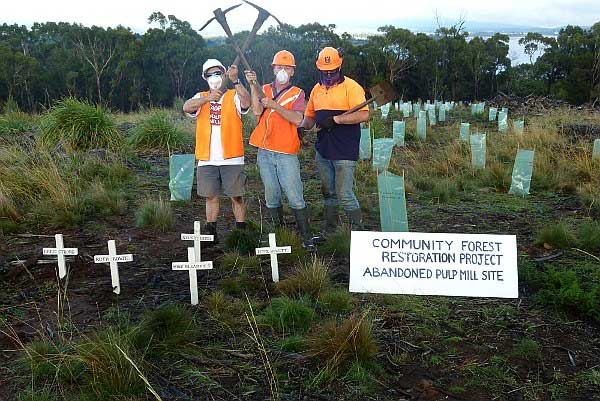
Today a squad from TAP Into A Better Tasmania's Forest Restoration Division planted native trees on a section of the Gunns abandoned pulp mill site at Longreach.
"We realize this is only a token restoration but we have been very much heartened by the success of our restoration planting in the Trevallyn Reserve following the vandalism by Gunns in 2009", said TAP spokesperson Bob McMahon.
"Gunns cleared an area of the peoples' Trevallyn Reserve, as well as the Longreach site, in a vain attempt to convince a fantasy investor that the proposed pulp mill was a goer. That was nearly two years ago and the pulp mill proposal has only gone backwards since", continued McMahon.
"We dedicate today's planting to the memory of 5 inspirational campaigners for social justice and a world scale pulp industry free Tasmania."
1. Stuart Leith, inaugural TAP member, who died at the helm of his yacht sailing down the Tamar to the TAP River Rally
in October 2006
2. Mike Bleaney from St Helens. Unqualified loyalty and support and a fighter to the end.
3. Ruth Rowe, TAP member. An indefatigable campaigner for the environment and social justice passed away recently aged 95.
4. Dr Peter Hewitt. One of his last public appearances was to address, from his wheelchair, a TAP demonstration outside Gunns offices.
5. Christopher Strong, former Headmaster of Launceston Church Grammar and passionate campaigner against monoculture plantations encroaching upon Tasmania's rural communities.
"It is our expectation that communities right around Tasmania will look to schemes for reversing the government sponsored corporate vandalism that has destroyed much of our productive forests and left much of our productive farmland under useless monoculture tree plantations," concluded McMahon.
CONTACT: Bob McMahon 0448 547290 or 63944225
7 March 2011 Gunns ASX statement disputed
Tamar Valley community organisations today denied claims that Gunns Ltd has been in consultation with them regarding Gunns proposed pulp mill.
Gunns Ltd’s CEO, Greg L’Estrange, in a statement to the Australian Stock Exchange and the Australian media, (3/3/11), advised that Gunns Ltd have been consulting with community groups as part of the approval process.
Community groups opposed to the Gunns pulp mill proposal categorically reject they have been in any way, part of any consultative process and advise that any inference that consultation has occurred would be misleading to investors and the ASX.
Community Groups reiterate that they remain completely opposed to the Gunns’ Tamar Valley pulp mill proposal.
TAP Into A Better Tasmania, Friends of the Tamar, Pulp The Mill.
20 October 2010. Community outrage at signing of Forest Statement of Principles
Bob McMahon from TAP Into A Better Tasmania responded to the signing of the Forest Statement of Principles by saying: "The three environment groups have signed an in-principle agreement for a pulp mill in Tasmania which Gunns and Shadforths are already claiming is a social licence for the Bell Bay pulp mill."
"Gunns’ share price rose 20% on the news of the agreement. The market cannot see any distinction between the environment groups’ support for a pulp mill and Gunns’ Bell Bay pulp mill. The environment groups have got some fast talking to do,” said McMahon.
"Gunns’ claim of a social licence for their pulp mill highlights the damaging tactical blunder made by the environment groups. They now face the near-impossible task of convincing their own members as well as the community at large, whom they have kept in the dark up until now."
"Similarly, the promotion of plantations by the environment groups will attract only condemnation from communities right across the state which have been damaged by the cancerous growth of monoculture plantations".
"The forest agreement fails to include principles of protecting water supplies sucked up by plantations and poisoned by herbicides and pesticides. There is no mention of protection of food- producing land, community health and rural community economic viability, all of which have been seriously impacted by plantations in Tasmania."
"The community has been deliberately excluded and serious issue with plantations deliberately ignored," continued McMahon.
A public meeting at Rowella last night arranged by TAP to discuss the collapsed housing market in the Rowella/Kayena/Sidmouth area metamorphosed into an outburst of anger and outrage at the actions of the environment groups.
"The word 'betrayal' was used repeatedly. I have to say the Greens copped a hammering as well," said McMahon.
"The meeting affirmed that Gunns had no social licence for their pulp mill. Not now. Not ever. The 45 residents who attended the meeting also affirmed that they were ready for the fight," concluded McMahon.
CONTACT: Bob McMahon 0448 547 290
3 September 2010. The ABC Stateline Transcript - Forestry peace talks have created a rift within green groups.
AIRLIE WARD, ABC PRESENTER: A resolution to Tasmania’s forestry conflict has been described as like trying to reach peace in the Middle East.
Players on both sides have held intractable positions so the fact they’ve made it to it the negotiating table has been cause for celebration.
Until last week’s leak of draft principles, the talks have been kept firmly under wraps.
Those principles include a three month progressive moratorium on logging high conservation value forests, the hand back of native forest and a pulp mill.
However, Stateline has learned that not all within the environment movement are happy with the negotiations.
Negotiators have been keen to present a united face and keep a lid on any descent.
BOB MCMAHON, PULP MILL OPPONENT: TAP, we’ve come under a lot of pressure from certain amounts of the Green movement to toe the line on this secret negotiation business and not to express our dissent, not to express our refusal to be part of it.
AIRLIE WARD: Tasmanians against the pulp mill, known as TAP, are not at the table but are worried about what might be negotiated.
BOB MCMAHON: There’s only one pulp mill proposal on the table and that’s the Tamar Valley pulp mill.
AIRLIE WARD: Stateline has learned there is broader dissent from members of Tasmania’s peak environment group at the negotiating table.
Environment Tasmania has a key role at the round table.
There’ve been four resignations from its management committee in recent weeks.
Chairman Peter Hay says his reasons were personal.
In his letter of resignation, secretary Kevin Knowles from the Meander Valley said,
“I’m a strong believer of a peak body that represents and assists all environment organisations in Tasmania.
I also believe in openness, transparency and due process. ET has failed to do that this.”
He added:
“I have serious concerns of the outside influences that are running the ET agenda and the legal ramifications involved with ET association with non-member organisations.”
Todd Dudley from North East Bioregion Network said he resigned because Environment Tasmania was too narrowly focussed.
Mr Dudley, who has been an environmental activist in Tasmania for over 25 years said he feared Environment Tasmania was only targeting forestry activities on public land and ignoring other environmental issues.
Deb Hunter who’s also quit, said she was busy doing her PhD.
None of those who resigned from Environment Tasmania would agree to an interview.
The environmental negotiators at the forestry round table have been disciplined about keeping talks in house.
That was reinforced this week in an email sent by Environment Tasmania’s Phill Pullinger to the round table’s forest reference group after Stateline started making inquiries.
“Some of you might be called by the ABC trying to dig up a story about splits within the environment movement and to ask you if you do get a call to not comment.”
BOB MCMAHON: Do they want to fail because once you start this secrecy, once you start muzzling people, that is the first step down the road to utter failure.
AIRLIE WARD: Bob McMahon from Tasmanian’s against the pulp mill says people should not be preventing from speaking out.
BOB MCMAHON: We have a particular view and it’s based upon our experience in Tasmania over the years that it’s far too much dealing being done behind closed doors, too many under the table type arrangements, semi cosy relationships. No we are very much opposed to the whole idea of secrecy.
Secrecy breeds suspicion.
AIRLIE WARD: Also leaked to Stateline were minutes of a meeting held by the forest reference group a couple of weeks ago.
Those minutes included a vote on whether biomass or plantation residue could be burned for renewable energy certificates.
Some concern was expressed to Stateline that the vote was recorded differently to how it was in fact made.
In his email to the forest reference group advising members not to speak to the media, Environment Tasmania’s Phill Pullinger warned:
“A former participant in the Forest Reference Group has been involved in leaking to a journalist at the ABC some specific discussion points of a previous Forest Reference Group meeting - which is obviously totally unacceptable.”
Bob McMahon says they have got a caucus mentality like major political parties which expect members to vote as a bloc.
BOB MCMAHON: It reminds me of a few totalitarian regimes actually Airlie, I think it’s a disgraceful state of affairs and this precisely what we’re objecting to.
AIRLIE WARD: Bob McMahon fears the negotiations are too one tracked.
BOB MCMAHON: You have got let’s say the environment groups going for a glittering prize, which is the cessation of all native forest logging and you’ve got the industry going for their glittering prize, which is is the Tamar Valley pulp mill.
You put both groups into a room, where do they meet?
Who compromises with whom?
AIRLIE WARD: Among the concerns expressed to Stateline were that native forest logging was dominating negotiations.
Some of the environmental groups said they were not opposed to selective harvesting, just the current scale of it.
Others feared it will mean an increase in plantations to provide stock for a mill.
Recently formed Our Common Ground has also had casualties.
Former State Labor forests minister Andrew Lohrey said he was no longer actively involved.
St Helen’s doctor Alison Bleaney admitted she has left Our Common Ground.
She said it was difficult to work out what they were doing and that she was concerned about the group’s focus and processes.
Lesley Nicklason, a campaigner from north east campaigner concerned about the spread of plantations also confirmed she is no longer with Our Common Ground.
None of those who have resigned from Our Common Ground were prepared to be interviewed.
Some environmentalists who spoke to Stateline were concerned about the relationship between Our Common Ground and Environment Tasmania.
They share office facilities and Our Common Ground member Rod West is Environment Tasmania’s landlord.
Sunday 1 August 2010. Public opinion poll - Gunns' planned pulp mill on the nose for voters
"Internal polling of the northern Tasmanian 63 telephone district shows a clear majority of the electorate is less likely to vote for a political party that intends to support Gunns proposed pulp mill with taxpayer funds," said TAP Into A Better Tasmania spokesman, Rod Hutchins.
The poll was carried out in late July 2010 by TAP Into a Better Tasmania. Voters were asked, "Would you be more or less likely to vote for a party intending to use taxpayers' money to support Gunns? proposed pulp mill?" Of the 258 Tasmanian voters surveyed, 55% said they are "less likely", 26% said they were "more likely" and 19% were unsure.
If the undecided are either excluded or distributed in the usual manner for polls, some 68% of voters are less likely to vote for a party that intends using taxpayer funds to support Gunns' proposal.
Rod Hutchins said, "The conspiracy of silence on the pulp mill from the major parties belies the continuing strong resistance to the proposal. This is the latest in a long series of polls that shows Tasmanians overwhelmingly don?t want it and don?t want governments to support it."
"A corrupted government pulp mill assessment has delivered a toxic lemon and the proposal must be axed now or resubmitted to the planning system for a complete and independent assessment at Gunns? expense. The assessment by the RPDC was foreshortened to supposedly avoid severe economic losses, and we now know that the project information was 'critically deficient'," said Mr Hutchins.
"The pulp mill proposal continues to threaten thousands of existing jobs in tourism, fishing, wineries and organic food production. Further investments and jobs in these clean industries of the future remain frozen while the pulp mill remains on the books," he concluded.
For further information contact Rod Hutchins
Spokesperson for TAP Into A Better Tasmania
21 June 2010. Forest talks set to fail
“Private discussions between environmentalists and forest industry groups to solve conflict over logging in the State are doomed to fail if the wide-ranging concerns of the public are not considered”, said John Day, spokesman for the community group TAP Into A Better Tasmania.
The proposed forestry roundtable to thrash out a way forward for the industry in Tasmania has been sidelined in favour of private talks between environmentalists and the timber sector.
“Environmentalists do not speak for communities hit by aerial spraying, lost jobs in food production, depleted water supplies, and many other impacts from the way forestry is currently practised”, John Day said.
“The fibre plantation wood supply for the proposed pulp mill is a major land use and imposes a huge burden on many for the benefit of a few”, he continued.
“A full independent risk assessment with community input is essential and must include the costs and impacts of all plantations on the Tasmanian people, public subsidies and the ability of the Government to fund basic essential services”, he said.
For further information contact:
TAP Into A Better Tasmania spokesman, John Day
16 June 2010. No Social Licence for a Pulp Mill or Plantation Forestry
“There will be no social licence for a pulp mill and its fibre plantation wood supply while the public continues to be excluded from the Round Table discussions and continues to carry the huge burden of uncosted impacts on health, water and jobs”, said John Day, spokesman for the community group TAP Into A Better Tasmania.
“The public is appalled that Geoffrey Cousins, Senator Brown and the Wilderness Society can somehow offer Gunns a ‘social licence’ in exchange for a particular type of pulp mill. This way of solving the issue is as badly flawed as the government’s one-sided benefits-only assessment of the pulp mill,“ he continued.
“Any proposal for a pulp mill anywhere must have a full independent risk assessment with community input. The assessment must include the costs and impacts of its plantation wood supply on the Tasmanian people, public subsidies and the ability of the Government to fund basic essential services first,” he said.
He went on, “Forestry is a major land use and imposes a huge burden on many for the benefit of a few. The people - rural communities, tourism businesses and many others - are suffering from stress and continued uncertainty, burn-off smoke and aerial spraying, lost jobs in tourism, depleted water supplies, and many other impacts from the way forestry is currently practised”.
“A pulp mill will cement in the burden of plantations over huge areas of the State and lock in the State to booms and bust of the global commodity cycles”, Mr Day said.
“There will be no social licence for a pulp mill and forestry while the public continues to carry the burden for the benefit of a few and remains excluded from the discussions.”
For further information contact:
TAP Into A Better Tasmania spokesman, John Day
5 June 2010. Forestry Round Table to fall over if community not involved
TAP Into A Better Tasmania welcomes Mr. Gay’s retirement as an opportunity to replace an outdated modus operandi with a more enlightened and acceptable approach to forestry and fibre plantations business. This is essential if the company is ever to achieve its much desired “social licence”.
TAP Into A Better Tasmania does not endorse the gushing valedictions of Mr. Lennon, the Labor Government, the Liberal opposition and a range of Forestry Industry spokesmen in recent statements about Mr Gay’s contribution to Tasmania.
The positive initial growth of the company and the industry has been totally destroyed by the debts hanging over the industry, the contractors and the investors. Tasmanians also have not been able to accept the wilfull waste that has occurred for years in our forests or the decimation of our bio-diversity and the destruction of our farmlands and communities by this industry.
Community concerns have not been considered, or have been sidelined; government promises have been repeatedly broken; as have alternative views or warnings, together with an industry wide failure to recognise changing market demands. Forestry Tasmania and the industry are, as a result, in a very poor condition to face the future.
It has been almost six years since the pulp mill project was first mooted and opposition to the project itself and the debauched manner of its procurement is as strong as ever. This is unlikely to change until true common ground is found between the community, the Government, the industry and the company.
Community members are still under considerable duress because uncertainty still surrounds the project and they do not have the confidence or will to grow or, in some cases, continue their businesses. They are unable to live their lives unfettered while there is a possibility that this still-proposed project could be commenced at any time.
Successive Labor Governments supported by the Liberal Party have blindly provided justifications, support, and subsidies for the still-proposed project. No company or industry should receive so much assistance, at the expense of providing basic public services to all Tasmanians. All assistance to industries or companies should be subject to an independent and fully holistic review before undertakings are given.
TAP Into A Better Tasmania recognises that the Forestry Round table is a generational opportunity to rebuild values, transparency and of course set up the industry for the future growth in opportunities for jobs and businesses. As well as Industry and Environmental representation, it is imperative that community groups have a direct input and equal say at the Round Table.
Community groups are concerned about the long term resource management values that government, Forestry Tasmania and the industry must adopt; to minimise the adverse effects on communities as it faces the current position and as it changes to meet future opportunities and challenges. All Tasmanians must be able to benefit without favour from our forest and fibre plantation resources, and we should be assisting those who want to progress all types of businesses and enterprises.
The community is concerned that:
• The proposed Forestry Round Table include direct community input) must start by undertaking an audit of all the existing aspects; including financial, subsidies and support, forest management and practices, planning approvals of our forestry related resources and timber processing and manufacturing industry. It must establish what demand and type of opportunities are available for our forest resource and industries, in Tasmania and in the world wide market place. This will require far more skills and input than the forestry industry representatives and environmental groups can provide. Plus there must be a community input. Only then can the impact, benefit and the financial and business opportunities be evaluated, to successfully plan for the future. Without this holistic approach, the successful future and true sustainable growth of our forest related industries and the innovation potential of all Tasmanian will not be realised. Conflict will continue. This process could be undertaken and completed within 12 months.
• $2billion worth of processed timber is already being imported into Australia each year. It is cheaper to buy overseas timber from our local hardwood stores than local timber. Almost all processed timber products (ply, mdf, beams, flooring, doors and window frames) are supplied from imported processed timber. Why is this when our forestry and timber industry receives huge grants and subsidies?
• “Common ground” - legal, moral and for all benefits must be provided equally for all Tasmanians now and in the future.
• Complete revision of management practices of our forests, short and long term, to ensure true long term sustainability, in every respect.
• Establishment of an open tendering scheme for the use of all forest resources.
• Additional fibre and timber plantations must receive planning approval taking into account council and community concerns, viability of regional community and services, water resources, bio- diversity, smoke generation, road and traffic conditions protection of food production land and landscape values.
• Future Government and industry policy, all development proposals, management and work practices must be based upon the Equator Principles and Forest Stewardship Council guidelines.
• All Ministers, Government departments, government businesses and authorities, to establish a public register of all matters raised by the community. This would register concerns, questions and complaints, with answers provided within 30 days on the public register.
• Establishment of a register of all purchases, stock holding, usage and disposal of all hazardous chemicals to be held by users and the government.
• To ensure that the establishment of the Integrity Commission is not delayed or diluted in anyway.
If the Government, the industry and the environmental groups proceed with the Round Table without direct community input, then another generation of polarisation and opposition will certainly ensue.
Contact for comment - John Day
26 February 2010. Gunns’ pulp mill gamble - we all lose
TAP Into A Better Tasmania said news today of Gunns Ltd’s 99 per cent profit slump will add further pain to workers throughout the Tasmanian woodchip industry, and worsen the plight of an already crippled sector.
It is now revealed that despite the best efforts of Tasmania’s Primary Industries Minister David Llewellyn, and the State Labor government, to sell woodchips cheaply, little has been achieved to alleviate timber workers’ job security and Gunns’ financial woes.
Gunns’ troubles will be compounded with the closures of its chip mills in Triabunna and Long Reach (Bell Bay) after Easter. (See ABC
‘Gunns have gambled the future of the company, and the livelihoods of all its employees, for a pulp mill pipedream’ said TAP spokesman, Bob McMahon.
‘Gunns has locked itself into an unsustainable woodchip mindset fed by the reckless dream of an unaffordable and unpopular mill’.
‘With only a $400,000 profit and share price at a 10-year low, Gunns would find it difficult to buy an average-priced home in Hobart, let alone be financially capable of building a $2.5 billion pulp mill,’ said Mr McMahon.
With vastly diminishing local jobs estimates, massive job shedding at Gunns, public subsidies in the hundreds of millions, and the enormous economic risk the project poses - not only to Gunns’ shareholders, but also to the wider Tasmanian economy - the pulp mill project must be put to death once and for all.
‘Why should innocent Tasmanians and our economy continue to be dragged along with this mess?’, said Mr McMahon.
‘Both the market and the public have lost confidence in Gunns. It is now in the grip of financial death throes, and only a miracle, or a massive subsidy from David Bartlett, can save Gunns now,’ he said.
Recent media reports have revealed Gunns’ financial problems include requiring public funds to pay for pulp mill pipeline infrastructure, being unable to find markets for its woodchip stockpiles, and a need for major redundancies to remain solvent.
Gunns’ shares peaked at $4.45 on 4 January 2005. Shares closed on Thursday 26th February 2010 at below 60 cents a share.
24 February 2010. Health alert: deadly water for Launceston and Tamar valley
The safety of Launceston’s and the Tamar Valley’s drinking water is seriously compromised warns TAP Into A Better Tasmania.
‘If we could issue a HEALTH ALERT we would’, said TAP spokesperson Bob McMahon, ‘Every parent, every mother, should be worried about the water that their child is drinking and the water that they swim or bathe in.’
The program, ‘Australian Story’ (ABC TV), has revealed that serious health and cancer problems exist wherever monoculture eucalypt plantations are grown near drinking water catchments on the east coast. (See Something in the Water - Part 2 )
‘The water catchment for Launceston and the Tamar Valley is arguably the most degraded large catchment in the state. The siltation of the Tamar Basin is one symptom of that degradation’ said McMahon.
Launceston derives approximately 70% of its water from the St Patricks River, 20% from the North Esk and 10% from the South Esk. The West Tamar water is 100% sourced from the South Esk.
‘I estimate that roughly 50% of the upper catchments of all these rivers have been clear-felled and converted to e. nitens (Eucalypt) plantations, much of which was destined for the Gunns proposed pulp mill,’ stated Bob McMahon.
‘Given the preliminary findings by Dr Alison Bleaney and Dr Marcus Scammell of toxic contaminants in the Georges River derived from the plantation trees themselves, it is critical that a comprehensive independent scientific study be done of Launceston’s and the Tamar Valley’s water.’
The area of the Launceston catchment under plantations is much greater than the Georges River catchment.
It is no longer acceptable to pretend there is not a catastrophe in the making. If toxic water is found in the Launceston and Hobart catchments, apart from public health issues, it would also prove to be disastrous to the bottled water and beverage industry.
The potential loss of the ‘Brand Tasmania’ image could cost millions in lost revenue.
It is critically important that the councils in this valley claw back planning powers that have been abrogated by the state government and Forestry Tasmania.
A nation that cannot safeguard its water supplies is a nation hell bent on suicide,” concluded McMahon.
12 February 2010. Gunns pipeline. where is Minister Sturges?
TAP Into A Better Tasmania calls on Minister for Infrastructure Graeme Sturges, to tell the Tasmanian community, especially those who live in the Tamar Valley, exactly what his Department knew in relation to the water pipeline for Gunns proposed pulp mill, and the Dilston Bypass.
‘The Department for Infrastructure, Energy and Resources has been prominent in its dealings with Gunns, providing a $240,000 gift from the public purse to the company for a pipeline culvert, and what appears to be another gift of compulsorily acquired land for its pipeline,’ said Bob McMahon, spokesman for TAP.
‘To date Minister Sturges has been conspicuous by his absence, but clearly there are some serious questions to be answered about this pipeline, and as the person responsible for his department he should not be shirking behind David Llewellyn,’ Mr McMahon said.
‘The pulp mill remains nothing more than a private company’s proposal, with no certainty of funding, yet Tasmanian taxpayers are being duped into paying for infrastructure for a non-existent and controversial project, when our roads, schools, hospitals and railway services are crumbling for lack of funds,’ he said.
Graeme Sturges met with Dilston residents and received a number of briefings about their concerns throughout last year.
Recent emails obtained under FOI highlight DIER’s complicity in the pulp mill pipeline, despite Premier David Bartlett declaring 18 months ago no further State Government support would be given to the pulp mill proposal.
DIER and mill supporters have previously denied links between the Dilston Bypass, and the water pipeline for the proposed pulp mill.
9 February 2010. Gunns steals private land and public resources for its pulp mill project
TAP Into A Better Tasmania today condemned the theft of private farmland through compulsory acquisition, to facilitate the construction of the water pipeline for Gunns Ltd’s proposed pulp mill.
Media reports today claim Gunns, and Department of Infrastructure and Energy Resources staff acting on behalf of Minister Graeme Sturges, have done secret deals for at least the past two years.
Gunns’ plan to run the pulp mill pipeline within an expanded easement, created at public expense, parallel to the Dilston Bypass and the East Tamar Highway.
This is despite assurances made by Premier David Bartlett in July 2008 that a ‘line in the sand’ had been drawn for Gunns’ proposed mill, and no further government assistance would be given to support the project.
‘Backdoor Backflip Bartlett’ has lived up to his name by saying one thing and doing another. When Gunns whistle, Bartlett jumps. In this case to provide a controversial pipeline across valuable farmland,’ said TAP spokesman Tony Saddington.
Plans to build the Dilston Bypass were heavily promoted by Liberal MP for Bass Peter Gutwein, Legislative Councillor for Windermere, and Launceston City Councillor Ivan Dean, and former federal MP for Bass Michael Ferguson, now a Liberal candidate for the March 20 State election. All support the controversial pulp mill proposal.
‘David Bartlett is on record stating no land will be compulsorily acquired for the pipeline. This is robbery by stealth, and it’s being financed by taxpayers because Gunns can’t afford to build it,’ said Mr Saddington.
5 February 2010. TAP supports Cundall’s accusations of corruption.
‘Labor and Liberal plotted to corrupt the legislative process in the Tasmanian Parliament’ stated TAP Into A Better Tasmania spokesperson Bob McMahon.
‘And they succeeded.’
‘Despite many public statements accusing Gunns of substantially drafting its own legislation to assess its pulp mill (Pulp Mill Assessment Act 2007), the latest by Peter Cundall, neither Gunns nor its fellow travellers in the Labor Government and the Liberal Party have denied the accusation,’ asserted McMahon.
‘Their silence confirms their guilt.’
‘All these parties determined to effect a coup d’etat by conniving in the corruption of Parliament and the corruption of due process in Tasmania,’ asserted McMahon.
‘Gunns was to draft the legislation with passing reference to the public service to put a gloss of legitimacy upon it. It then shot through Parliament at the speed of light and came out the other end with a wholly predictable rubber stamp.’
‘For those who have wondered why the Pulp Mill Assessment Act is so obscenely favourable to Gunns, especially Section 11 which denies the public access to its own legal system for redress from pulp mill impacts, it is because they wrote it.’
‘Furthermore, prior to the Gunns wholly predictable withdrawal from the RPDC in March 2007, the full resources of the public service were made available to Gunns for the drafting of their proposed pulp mill Integrated Impact Statement and related work.’
‘Putting aside the legality of a government subverting public institutions for the benefit of a company, at what cost to the Tasmanian public did those hundreds, perhaps thousands of working hours devoted to supporting the Gunns’ bottom line come?’ asked McMahon.
‘We are going through a tragic time in the history of Tasmania and it is only possible to press the restart button if the PMAA is repealed. The stench of corruption surrounds that document like road kill on a hot day,’ concluded McMahon.
In the lead up to the State election, TAP will target those politicians who were party to the subversion of parliament and the legislative process. TAP’s aim is to force politicians to answer for their corrupt actions.
11 November 2009. Gunns gains finance. Joint Venture Partner is a Japanese Pulp and Paper group. Federal and State Labor collude in the deal.
“Highly confidential information was made available to TAP on the evening of November 10th,” stated TAP spokesperson Bob McMahon.
“The information throws up the following serious questions,” continued McMahon.
- Is it true that Gunns Ltd has managed to find finance to construct its pulp mill through a joint venture partnership with a Japanese Pulp and Paper Group (unnamed)?
- Is it true that in order to achieve this joint venture partnership Gunns has been obliged to give away between half and two thirds equity in Gunns Ltd?
- Is it true that the Tasmanian State Labor Government and Federal Labor Government were party to the deal and made it possible by giving guarantees that only governments can give?
- Is it true that the Tasmanian Labor Government has provided resource guarantees of land, forests and water as well as guaranteeing compulsory acquisition of land for the pulp mill water pipeline easement?
- Is it true that the Federal Government has guaranteed subsidies for capital works and equipment?
- If the Federal Government is providing assistance, then how does this square with the requirement under the EPBC Act for Gunns to complete hydrodynamic modelling and for the research to be assessed by the Federal Government prior to their granting approvals?
6 November 2009. Bartlett allowed clearing on pulp mill site when permits had expired
Why has Bartlett allowed work to begin on the pulp mill site when permit concerns were raised with the EPA last July?
TAP Into A Better Tasmania expressed outrage today that community concerns have again been disregarded by Tasmania's State Government.
Questions about the permit conditions for Gunns Ltd's proposed Pulp Mill were raised with the Environmental Protection Authority over three months ago, but continue to remain largely unacknowledged by David Bartlett.
The legality of land clearance beyond the permit deadlines has also been criticised by members of the University of Tasmania's Law Faculty.
"The clearing of vegetation from the mill site began in early August, and concerns were immediately expressed to the EPA, and to several key government ministers, querying the legality of the work. We are furious that despite loud warning bells, no-one was listening" said TAP spokesman Tony Saddington.
"We have concerns that site work carried out by Gunns would contravene the Pulp Mill Assessment Act, given that Gunns have cleared vegetation without the necessary permits. David Bartlett has allowed destructive land clearing to take place while ignoring the community's concerns, and with no suggestion Gunns should have penalties imposed for breaching permit conditions," he continued.
TAP said the Government should have called for an immediate suspension of work at the Long Reach site until questions relating to permit issues had been addressed.
"David Bartlett is repeating the errors of his predecessor Paul Lennon in allowing expired permits to be revived through a fast-tracked extension. That Gunns have failed to attract finance, or the interest of a Joint Venture Partner is clearly shown by David Bartlett's cynical extension of the time frame to 2011. But his decision has condemned Tamar Valley residents to a further two years of uncertainty and despair.
"If government arrogance and lack of adherence to proper process is what the community can look forward to, then our fears about this project would seem to be entirely justified. And the iniquitous PMAA prevents any right of appeal by any individual or business should the mill cause any harm whatsoever to their health or livelihoods," said Mr Saddington.
TAP is still waiting for answers to questions asked of senior ministers in relation to this issue.
4 November 2009. TAP condemns new legislation to revive the pulp mill.
TAP condemned the decision by David Bartlett's government in extending permit conditions for the proposed Gunns' Pulp mill by a further 2 years.
David Bartlett promised Tasmanians an end to the pulp mill uncertainty by Christmas last year, and suddenly with the permits expired, the ALP is now in the process of fast tracking legislation that will continue division in the community for a further 2 years said a TAP spokesman.
"We have fought against this mill for 5 years in order to keep local jobs in the Tamar valley. David Bartlett has now ensured that the community will continue the fight to protect its health, jobs and livelihood" he continued.
"We will not give up. Any potential partner, buys into extremely strong community opposition."
12 October 2009. TAP has warned politicians and commentators against “jumping to self-serving conclusions over the alleged ‘attack’ on John Gay’s house.
“A witness has reported to TAP that the graffiti on John Gay’s property was composed of some squiggles and a drawing of a penis. We have no information about the alleged ‘smoke bomb’, TAP spokesperson Bob McMahon said today.
“It was entirely predictable from past performances that fingers would be pointed at the anti-pulp mill community organization TAP, for the alleged ‘attack’ on John Gay’s house”, he said.
“And how self-serving for pulp mill supporters to do so.
“We live in a very divided community and we do well to ask ourselves how this came about and who is responsible?” he continued.
“The State Government and its proxy, Gunns Ltd, have deliberately ignored community concerns about the impact of the proposed mill on jobs, health and investments in the Tamar Valley and throughout Tasmania.
“This is toxic to community cohesion”, he said.
“In addition, the State Government in collusion with Forestry Tasmania and Gunns Ltd, has continued to operate and subsidise at public expense an outmoded monopolistic forest industry that has forced forest contractors out of business and Gunns employees onto the scrap heap.
“It’s a great credit to Tasmanians that given all the hurt and provocation they have largely avoided violence and damage to property and have not lowered themselves to the standards of the State Government and certain other players”, Mr McMahon said.
13 September 2009. Community group TAP to confront Gunns pipeline land clearing in the Trevallyn Reserve.
WHAT: Vegetation planting on Gunns land clearing site
WHERE: Trevallyn Reserve just behind WAY FM radio station Reatta Rd Trevallyn
WHEN: 11.00am Sunday 13th September
“Several weeks ago Gunns cleared land in the Trevallyn Reserve. This was meant to convince fantasy investors and the State government that ‘substantive’ work on the pulp mill had begun and that the pulp-mill was ‘investment ready’,” said TAP spokesperson Bob McMahon.
“It was a con. Gunns have made no such substantive start nor are they in the financial position to do so in the foreseeable future. Gunns have trashed public land as part of an immoral hoax,” continued McMahon.
“This Sunday TAP will begin the rehabilitation of the public land vandalised by Gunns by planting native trees and grasses. We will also erect signs which read EXCLUSION ZONE: GUNNS KEEP OUT.”
“Gunns may pull out our bush restoration work but they should be aware of the deep anger across Tasmania at the way their monoculture plantations have swamped the landscape and taken up some of our best food producing farm land, deprived existing farms of water and polluted our waterways with toxic chemicals,” said McMahon.
“My reading of the public mood is that if Gunns pull out our bush restoration work I fear it just may precipitate a tit-for-tat pull out of Gunns plantations across the state,” concluded McMahon.
CONTACT: Bob McMahon 0448 547290
8 July 2009. Tony Burke, Minister for Agriculture, Fisheries and Forestry has misled Parliament and should be relieved of his portfolio.
“It’s time for the Prime Minister to cut Burke loose. Not only is Burke a plagiarist, a shameless proponent of vested interest and incompetent in his portfolio, but most seriously of all, he has misled Parliament,” stated TAP Into A Better Tasmania spokesperson Bob McMahon.
“Having nakedly plagiarized the Gunns website in his pulp mill spruiking speech to Parliament on June 24, he also misled Parliament by claiming the mill would create 8000 long-term jobs.
“Not even John Gay, the notorious amplifier of the benefits of the proposed pulp mill claims that number of jobs. In a puff piece published in the Examiner July 7, Gay claims 1600 long-term jobs.
“With Burke and Gay making wildly different job claims, it’s about time Burke was made to account for the missing 6400 jobs, and then clean out his desk and move to the back benches,” continued McMahon.
“He went too far in spruiking the supposed benefits of the proposed mill and has paid no heed to the costs, risks and impacts on existing agricultural and fishing businesses in Tasmania should the mill go ahead.
“Just like his predecessor Eric Abetz, only the Forestry part of Minister Burke’s portfolio interests him. Agriculture in the Tamar region and the Bass Strait fishery can all go to hell as far as this man is concerned.”
A community delegation organized by TAP Into A Better Tasmania will be attending the ALP National Conference in Sydney July 30 – August 1 to demand Burke’s removal from his portfolio and the appointment of someone who really cares for food production in Australia.
For further information contact:
Bob McMahon, Spokesperson for TAP Into A Better Tasmania, phone 0448 547 290, email bob@orielstudio.com.au
28 June 2009. Who is the government working for, foreign operatives or the Tasmanian public?
“Federal Minister for Agriculture, Fisheries and Forestry Tony Burke last week flagged using taxpayer subsidies to make it more attractive to foreign operatives to take control of Gunns’ planned pulp mill and Tasmania's resources” said TAP Into A Better Tasmania spokesman, Bob McMahon.
But a new state-wide EMRS poll shows two in every three Tasmanians don’t want the planned Tamar Valley pulp mill to go ahead because it will result in foreign operatives effectively controlling Tasmanian water, land and forests.
The poll was commissioned in mid-June by TAP Into a Better Tasmania. Of the 800 Tasmanians surveyed, 65% said “no” the government should not allow the pulp mill to go ahead if it results in foreign control, 26% said “yes”, and 9% were unsure.
Bob McMahon said, “The recent endorsement of Gunns’ pulp mill by the Federal Minister Tony Burke shows Labor is working for effective foreign control of our land, water and forests. But according to the latest EMRS poll, Tasmanians overwhelmingly don’t want it”.
“Labor should know better than to rely on those with a conflict of interest in Gunns and the CFMEU for advice to get behind a project that has failed to analyse the risks, failed to make a proper business case, and failed the best interests of Tasmanians,” Mr McMahon said.
"If this was a reputable business it would have attracted reputable finance. It did not. The ANZ, quickly followed by other Australian and foreign banks wanted nothing to do with it. That's why Gunns are trawling the world with cap in hand looking for a ‘Khemlani’. That's why the CFMEU dominated federal Labor are spruiking the mill on John Gay's behalf. What Minister Burke is doing is far more serious than what Rudd and Swan have been accused of over the car dealer John Grant affair," he continued.
For further information contact Bob McMahon, Spokesperson for TAP Into A Better Tasmania
26 June 2009. Federal Minister for Agriculture, Fisheries and Forestry, Tony Burke’s big mistake
“Federal Minister for Agriculture, Fisheries and Forestry Tony Burke is looking very foolish today having relied on partial and biased advice from Gunns and the CFMEU to endorse Gunns’ planned pulp mill,” said TAP Into a Better Tasmania spokesman, Bob McMahon.
“Tony Burke should know better than to rely on those with a conflict of interest for advice to get behind a project that has failed to analyse the risks and failed to make a proper business case,” Mr McMahon said.
“No reputable banker will touch the project and it has proved unacceptable everywhere else in the world", he continued.
The State and Commonwealth’s own RPDC assessment found the Gunns proposal critically deficient in eight areas. There has been no risk assessment to Treasury standards, no socio-economic and environmental analysis, and no analysis of the costs.
Even the assessment by Sweco Pic did not examine noise emissions, impacts on surface or estuarine waters, effects on flora and fauna, transport implications and social and economic effects, nor construction impacts, nor impacts from off-site infrastructure development such as the raw water supply pipeline, effluent pipeline or the quarry.
Mr McMahon said, “The federal Minister has gone out on a limb and ignored the agriculture and fisheries responsibilities of his own portfolio by publicly backing Gunns' proposed pulp mill for the Tamar Valley.”
At risk are many wine-making, organic food and horticultural small businesses that thrive in the region and 2600 tourism-related businesses in Launceston and Tamar Valley.
Risks to Tasmania’s fishing industry due to dioxin contamination from pulp mill effluent stand to cost the industry $693.5 million and 700 job losses over the life of the project (Tasmanian Round Table for Sustainable Industries Project www.lec.org.au).
"Tasmania's hard-won clean reputation as a producer of fine seafood, wine, and a range of high quality produce in the agricultural and horticultural industries, stands to be gutted by Burke’s unquestioning acceptance of biased lobbying by the CFMEU," Bob McMahon said.
Not one survey or poll conducted either statewide or nationally during the past five years showed majority support for the mill.
For further information contact:
Bob McMahon, spokesperson for TAP Into a Better Tasmania
12 June 2009. Södra’s profits at risk if the Swedish company invests in Gunns’ planned pulp mill
The community through its organisation TAP into a Better Tasmania has pointed out a significant and undisclosed risk to Södra’s bottom line should the company decide to invest in Gunns’ pulp mill planned for the Tamar Valley, Tasmania.
Spokesman for TAP Into Better Tasmania, Mr Tony Saddington, said that “It is unlikely that Gunns has pointed out their dependency on direct and indirect government subsidies because Gunns has neither reported on these in its Integrated Impact Statement nor report the subsidies in their books”.
“Given the scale of these subsidies, their potential loss to Gunns and forestry in Tasmania poses a significant risk to the future value of Södra’s investment as the global financial downturn forces governments to look for ways to cut back on expenditure.” he continued.
Mr Saddington said that “Governments are coming under increasing pressure as a result of the global financial crisis to reign in spending, recoup costs and reduce subsidies in the face of backlash from voters who are increasingly angry with the loss of essential services”.
“The dependence on subsidies means that neither Gunns nor Södra can guarantee the future bottom line profitability of the proposed pulp mill. Professional business consultants have advised us that the most responsible decision for Södra is to wait until the scale and type of subsidies is clear and the risks clarified,” he continued.
Mr Saddington said that “The profitability of Gunns Ltd has long been artificially propped up with a wide range of taxpayer subsidies and a cash subset of forestry related subsidies have also been identified in an independent study by economist Graeme Wells”, www.tasmaniantimes.com - Wells economic report.
TAP estimates subsidies for the pulp mill project and forestry to include losses to other businesses and the community of more than $3.1bn, one time diversion of taxpayer dollars of $399m (so far) and ongoing subsidies of $360m/year Pulp finance - the risks.
TAP Into a Better Tasmania was not included in Södra’s recent investigation of Gunns’ project but has written to the CEO of Södra, Mr Leif Brodén outlining the investment risks.
Mr Saddington said “The scale of many subsidies is not precisely known as there has been no socio-economic and environmental analysis of the pulp mill proposal or an analysis of cost side of a cost-benefit study. Neither has there been a risk assessment to Australian Treasury standards of the pulp mill project.”
Consultant Sweco Pic’s assessment of the project “does not include … noise emissions, impacts on surface or estuarine waters, effects on flora and fauna, transport implications and social and economic effects, and does not include construction impacts and does not include impacts from off-site infrastructure development such as raw water supply pipeline, effluent pipeline or quarry” (p12 Assessment of the Gunns Limited Bell Bay Pulp Mill Against the Environmental Emission Limit Guidelines, 25 June 2007)
There is considerable community disquiet about the assessment of the project with only 26% agreeing with the Government's fast-track process, 64% disagreeing and 10% unsure (8 August 2007 EMRS statewide poll. Opinion polls.
Also, 26 of 27 opinion polls conducted from 2005 to the present show a majority of Tasmanians and Australians are opposed to a Gunns’ pulp mill in the Tamar Valley. Only one local poll in George Town near the proposed pulp mill, showed majority support (53% to 47%) in February 2008.
For further information contact Tony Saddington
16 May 2009. Was the Meander Dam built for Gunns?
TAP Into a Better Tasmania spokesman Mr Tony Saddington said “The Water Minister David Llewellyn has a golden opportunity to put to rest the rumour that the Meander Dam was built for Gunns pulp mill”.
“Instead of claiming it's not true, Mr Llewellyn can squash the rumours once and for all by explaining how there was enough water available from existing supplies in Great Lake to release into the South Esk for Gunns mill during dry summers”, he said.
“TAP is looking forward to sound evidence from the Minister that there would be water available for all every summertime including Launceston’s drinking supplies, environmental flows in the Gorge, planned diversions to the midlands, and for farmers future irrigation needs," he said.
“The Minister must also tell us all how much Great Lake levels are expected to drop due to global warming and how much South Esk river levels will drop from Gunns plantations in the headwaters,” he continued.
Great Lake which supplies most of the water to the South Esk is near all time lows.
"If there will be enough summer flow in the South Esk without topping up from the Meander Dam over the next 30 years, then any rumour that it was built for Gunns is completely false," said Mr Saddington.
“Its over to the Minister to explain rather than blame”, he said.
12 May 2009. Stink over bumper sticker
TAP Into A Better Tasmania spokesperson Judith King said today that the bumper sticker ‘I no longer shop @ Gunns’ reflects the deep anger, fear and frustration by many over the threat to their jobs posed by Gunns’ planned pulp mill.
“Some 2600 tourism related businesses in Launceston and the Tamar Valley and more than 2000 jobs are threatened by foul smells from Gunns’ mill,” she said.
The odour that comes from all kraft pulp mills smells like a mix of stale sewage, rotting cabbage, rotten egg gas and burning rubber, and spreads up to 60k away including Launceston, Deloraine, Longford and Bridport.
“Gunns retail manager, Mr Legro could help by explaining to tourism and related industries that depend on Tasmania’s clean brand how the Gunns’ Board decision to site the mill in the Tamar Valley does not threaten thousands of existing jobs. When that happens, we can all breathe a sigh of relief,” said Mrs King.
11 May 2009. Not every Tasmanian works at Gunns
TAP Into A Better Tasmania reminds Gunns about those other jobs at risk from the proposed pulp mill
TAP Into A Better Tasmania rejects claims made by Gunns Retail Division General Manager, David Legro that a car bumper sticker ‘I no longer shop @ Gunns’ threatens the company’s retail staff jobs.
While the community group acknowledges the downturn in the economy adds to the widespread job insecurity being felt throughout the state, spokesperson Judith King reminds Gunns that Tasmania’s shopping options for hardware goods are not limited to Gunns’ retail stores, and these alternative stores also employ a significant number of Tasmanians.
“Many northern Tasmanians that I’ve spoken to say they haven’t shopped at Gunns for years. The sticker simply reinforces a decision people made a long time ago, due to community frustration and anger at the company’s refusal to heed their concerns about the many unanswered risks associated with the pulp mill,” she said.
TAP Into A Better Tasmania is fully supportive of The Examiner’s Buy Locally campaign given that so many of its members and supporters own and operate small businesses that rely on a Tasmanian client base for much of its custom. These are the agriculture, tourism, fine foods and fishing businesses, which collectively employ over 2000 Tasmanians. The long-term viability of these businesses and jobs have been under threat of the pulp mill for the past five years.
1 May 2009. Gunns planned pulp mill to cost thousands of Tasmanian jobs
TAP Into a Better Tasmania is concerned that the extreme claims by Gunns, CFMEU and Timber Communities Australia about the planned pulp mill are threatening thousands of existing Tasmanian jobs in fine food production, wineries, agriculture, tourism and fishing industries during impending hard times.
“The planned pulp mill will cost the State economy up to $2.1billion and 2088 jobs lost in tourism alone, according to the Business Round Table Report,” said TAP Into a Better Tasmania spokesman Tony Saddington.
“Then there are the risks to health and other industries plus government subsidies to Gunns,” he continued.
The Report by independent economists (www.lec.org.au) goes on to say that overall, “the pulp mill project may cause an economic loss to the State of Tasmania.”
Mr Saddington said, “No sane business operator would listen to only one side of a proposal and Tasmanians are smarter than that”.
“The Roundtable report is the only public independent examination of all the costs, benefits and risks of Gunns proposal,” Mr Saddington continued.
Gunns’ own Integrated Impact Statement is “critically deficient in 8 key areas” (RPDC) and the government’s consultant report (ITS Global) is a one-sided benefits-only study.
Mr Saddington said, “Gunns mill proposal threatens thousands of existing jobs during impending hard times. The planned pulp mill not only threatens our local ‘clean green’ reputation abroad, but employment prospects across the state.
Rather than being a job creator, Gunns is a jobs shedder and the Labor government has refused to help those log truck drivers and timber harvesters in distress with a bail-out package debated in Parliament a few months ago.
Scott Maclean of the CFMEU Forestry division and Eva Down of Timber Communities Australia are failing to do their job of looking after workers by negotiating with their employer and the State Government.
Further information; spokesman for TAP Into a Better Tasmania, Tony Saddington
22 November 2008. Premier David Bartlett - “The line in the sand”
73% of Tasmanians agree with your ending support for Gunns’ planned pulp mill from 30 November. A sustainable industry doesn't need our help.
No more infrastructure, wood-supply and sovereign-risk agreements.
Governments give more than $300m a year in subsidies and cost relief to Gunns and forestry.
It’s time to stop the haemorrhage and resuscitate funding to our hospitals, schools, the disabled and aged.
12 August 2008. TAP kicks off two weeks of civil unrest
Calendar of events
15 August Friday 2.00-3.00pm West Tamar Council Chambers at Riverside.
Demonstration to impress upon the West Tamar Council that the ratepayers will not tolerate the Council allowing Gunns free access for the proposed pulp mill pipeline to land owned by electors.
19-21 August Tuesday – Thursday Albert Hall Launceston
People's Parliament in City Park outside the Launceston sitting of the politician's Parliament in the Albert Hall.
20 August Wednesday 6.30-8.30pm Gunns Pulp Mill and Climate Change Public Forum
Tailrace Centre, West Tamar Highway, Riverside facilitated by Environment Tasmania and including representatives from Gunns and Forestry Tasmania.
23 August Saturday 12.00pm Rally and March City Park Launceston
SPEAKERS Bob McMahon (TAP), Rachel Maynard/Nala Mansell (TAC), Peter Cundall (TAP), Dr Warwick Raverty (formerly of the RPDC), Kim Booth MHA, Terry Martin MLC, Phillip Pullinger (Environment Tasmania) Stef Gebbi/Gabby Forward (Students Against the Pulp Mill)
One of the main outcomes of the Rally will be a demand for a repeal of the Pulp Mill Assessment Act 2007, in particular the pernicious Section 11 which denies the people of Tasmania access to their own legal system.
26-28 August Tuesday – Thursday Parliament, Albert Hall, Launceston
People's Parliament in City Park outside the Launceston sitting of the politician's Parliament in the Albert Hall.
27 August Wednesday Parliament
Kim Booth MHA (Greens) tables a private member’s bill to repeal the Pulp Mill assessment Act 2007. A big community presence is expected inside parliament for the debate.
Bob McMahon - media spokesman Tasmanians Against the Pulp Mill
June 24th 2008. Tasmanians write to Prime Minister in Chinese
As a last resort Tasmanians have written to Prime Minister Rudd in Chinese.
“We apparently have a Prime Minister who doesn’t understand English”, asserted TAP spokesperson, Bob McMahon. “Therefore we have written to him in Mandarin, a language in which he is reputedly fluent.”
“No matter how often we write to him or his ministers in English, concerning the socio-economic, legal and environmental impacts of the proposed pulp mill, we are sent bizarre forest industry propaganda and information sourced from the pulp mill proponent, by way of reply. Does Kevin Rudd have any idea how insulted the people of Tasmania are at this behaviour of Federal Labor?” continued McMahon.
“There is a chance that Rudd’s advisers and ministers are blocking our correspondence to the Prime Minister in their effort to run an unseemly and ill-informed pro-pulp mill line. We are trying to inform the Prime Minister that he has been led astray. That is why we have written to him in Chinese.”
The letter was sent Priority Post on June 2nd 2008. As yet there has been no reply.
“There has never been a full assessment of the Gunns pulp mill proposal. The disenfranchised people of Tasmania are, in this letter, demanding that one be undertaken,” said McMahon.
Many independent groups and individuals have expressed severe reservations about the risks, potential hazards, location, costs and supposed economic benefits of the mill. They include CSIRO, ANZ Bank, RPDC, former member of RPDC pulp mill panel Dr Warwick Raverty, National Toxics Network, Beca Amec and 128 independent scientists.
None of the serious concerns raised by these groups and individuals have been assessed, nor have any steps been taken to protect the public from the identified hazards.
“There can be no way forward in Tasmania unless Federal Labor and State Labor understand that the huge risks the Tasmanian communities have been exposed to represents a massive breach of faith between our paid representatives and the taxpayers who pay them,” said McMahon.
“We want equal treatment with Gunns and the forest industry. For too long they have had many favours supplied at taxpayers’ expense, from legal, resource and cost exemptions to huge and unaffordable subsidies.”
“As long as one group is treated differently under the law and provided with preferential access to the ear of government, there can be neither fairness nor equity in Tasmanian society. Remedy this situation, Mr Rudd, or lose Tasmania,” concluded McMahon.
CONTACT: Bob McMahon 0448 547290
Email bob@orielstudio.com.au
Text of Mandarin letter in English
“Incompetent aides shielding a good king are like clouds overcasting the sun and the moon”
In the past, Bi Gan cut open his heart to show his loyalty; Qu Yuan committed suicide to warn the king of corruption.
These days, we people in Tasmania have to write the Prime Minister a letter in a foreign language as a last ditch attempt to get your attention. We have written numerous times to Canberra about the Tasmanian pulp mill and were stonewalled.
We represent a broad community in Tasmania who are deeply concerned about the economic, social and environmental wellbeing of Tasmania. We are in grief that our voices and concerns have been ignored by the Tasmanian Premier and the Minster for Environment, Heritage and Art. As a group who supports the Prime Minister and its new government and directions, we understand our concerns may not have been brought to your attention as you are inundated with various issues.
After consulting various stakeholders in Tasmania and conducting extensive internet research on similar pulp mills around the world, we opine that:
In calculating the economic benefits the pulp mill may bring to Tasmania, other social costs should also be considered, such as expenditures on building new roads, maintenance of roads, supplying water at a low price, health issues arising from environmental pollution and the subsequent costs of health care. If these costs, estimated to be over $250 million per year, are excluded from the calculation, it is the community who will eventually have to bear these costs. This will be a form of subsidy to a private company at the expense of the general public in defiance of the spirit of democracy.
The socio-economic risks of the pulp mill are extremely high. Official assessment covered only 15% of the total impacts that we gathered from consultation and research. The official assessment was incomplete.
Ignoring public voices and proceeding regardless is like “plugging one's ears while stealing a bell”. The people’s voices will get louder and louder and the government will eventually suffer in consequence.
We urge the Federal Government to conduct a detailed and independent review of the pulp mill proposal before it is built. The Government should fully consider the interests of all Tasmanians and its industries, including impacts on tourism, operating and production environment, quality of life as well as property values. If the Government only listens to one party by getting information and data from the logging industry alone, how can you fairly govern your people? How can you convince your people of the correctness of your policy?
We look forward to meeting the Federal Government and offer a briefing on the political, social, economic and health costs and risks that have been ignored so far.
“The Great Learning teaches the display of illustrious virtue, the caring for the people, and repose in the highest good.” The Prime Minister should care for the people by listening to us directly and seek a satisfactory solution to the issue.
“Wretched flies turn black to white. Blandishing opinions distance one from one’s closest allies.” In a democracy, your closest allies are the voters and we appeal to the Prime Minister to keep this in mind.
Signed on behalf of the disenfranchised people of Tasmania
Robert McMahon
26 May 2008
19 May 2008. The failure of Gunns to comply with requirements imposed by the Commonwealth Chief Scientist is exposed by TAP.
“Gunns Ltd have failed to provide accurate and substantive roadkill data for threatened species, on three major access routes to their proposed pulp mill as required under Condition 26 of the Environment Protection Biodiversity Conservation Act 2007/3385,” said Tony Saddington, TAP Roadkill Monitoring Co-ordinator.
“With the evidence before him there is no way the Minister for the Environment, Peter Garrett, can sign off on the inadequate work done by Gunns. The threatened species surveys must be redone to an acceptable standard,” Mr Saddington continued.
To manage the risks to threatened species, the Chief Scientist required Gunns to “immediately following the date of the approval, establish baseline monitoring of roadkill along the East Tamar highway and other major access routes for construction.”
“Threatened species data for the West Tamar, Frankford and Bridport Highways was not collected,” said Tony Saddington. Gunns’ roadkill surveyor was contracted to undertake a monitoring program only on the East Tamar Highway.
The Chief Scientist (Rec. 2.1.2.6.) required daily surveys by Gunns but Mr Saddington said “weekends and public holidays appear to have been unmonitored and evidence exists that carcasses were occasionally removed prior to the arrival of Gunns’ survey crew.”
Data were not collected for 80% of the daily three month monitoring program as required by the Chief Scientist. In addition, for the first 6 of 24 sampling runs, data was collected over only one quarter of the 33km East Tamar Highway.
Since October 2007 TAP has been conducting its own daily roadkill monitoring along 22kms of the East Tamar Highway to ensure accuracy and compliance by Gunns with acceptable standards of quality assurance and quality control. TAP’s early morning seven days a week survey included species identification, GPS location and dated digital photos of specimens.
Significantly TAP has identified and independently confirmed fifteen carcasses belonging to threatened species out of a total of 656 specimens. Gunns have only recorded five out of 272 specimens.
20 February 2008. To pulp or not to pulp: public forum on alternative futures for Tasmania’s forests
Decisions by Forestry Tasmania about the State's forests centre on producing one main low value product – pulp wood, but at what cost?
Tasmanians Against the Pulp Mill (TAP) is holding a public forum on alternative futures for Tasmania's forests including as a source of energy, as a carbon store and as protector of water supplies.
Engineer and co-presenter Mike Scott said, “By committing long term to pulp wood, we lose the use of forests as a source of energy (biofuels) to replace fossil fuels in a post peak-oil future”. “Focusing on one main product discourages diversity and stifles our ability to adapt to rapidly changing demands.”
“In contrast to Tasmania, progressive nations are looking towards a variety of products to extract the maximum value from the forest for all users and with superior environmental benefits,” he continued.
“Biofuels will become an increasing necessity in the fight to reduce carbon emissions and we must fundamentally rethink our lifestyle choices in the face of escalating damage to our planet from profligate use of fossil fuels” .
Co-presenter Kim Booth, Greens MHA, said, “Native forest woodchipping in Tasmania is like mining, but our forests are important in many other ways such as for landscape, biodiversity, tourism and eco-tourism, water supplies, specialty timbers and environmental services such as carbon stores.”
Master forester Frank Strie will also discuss uptake of carbon, responsible forest and catchment management. “The silt in the Tamar basin was once soil further up in the catchment, on the slopes and on the bank of streams and rivers. We must have new thinking about the ways of managing the forest to bring genuine environmental, economic and social benefits,” he said.
The forum will also examine the economics of a future forest-based biofuels industry.
Forum details
When: 7pm - 9.45pm Monday 25 February 2008.
Where: Riverside Community Centre, off Brownfields Lane behind the Riverside High School, West Tamar Highway, Launceston.
17 September 2007. Voters to block pro-mill political candidates
Thousands of Tasmanian voters have pledged not to vote for any local, state or federal political candidate who supports Gunns’ proposed pulp mill in the Tamar valley.
Bob McMahon, spokesman for Tasmanians against the Pulp mill (TAP), said, ’11,100 voters have signed the “Voters Block” not to support any pro-mill political candidates at elections’.
‘This is a potent political statement for any candidate, particularly those in marginal electorates,’ said McMahon. ‘The numbers are growing daily.’
‘The people are angry at the appalling orchestrated and covert support by the Lennon government for the pulp mill, the loss of democracy and the downward spiralling standards of governance in Tasmania,’ said Bob McMahon.
For the imminent Federal Government and local council elections, TAP will be polling all candidates for their views on the proposed pulp mill.
‘We will advertise the results and distribute cards in all electorates showing how to vote against candidates who support the pulp mill,’said McMahon.